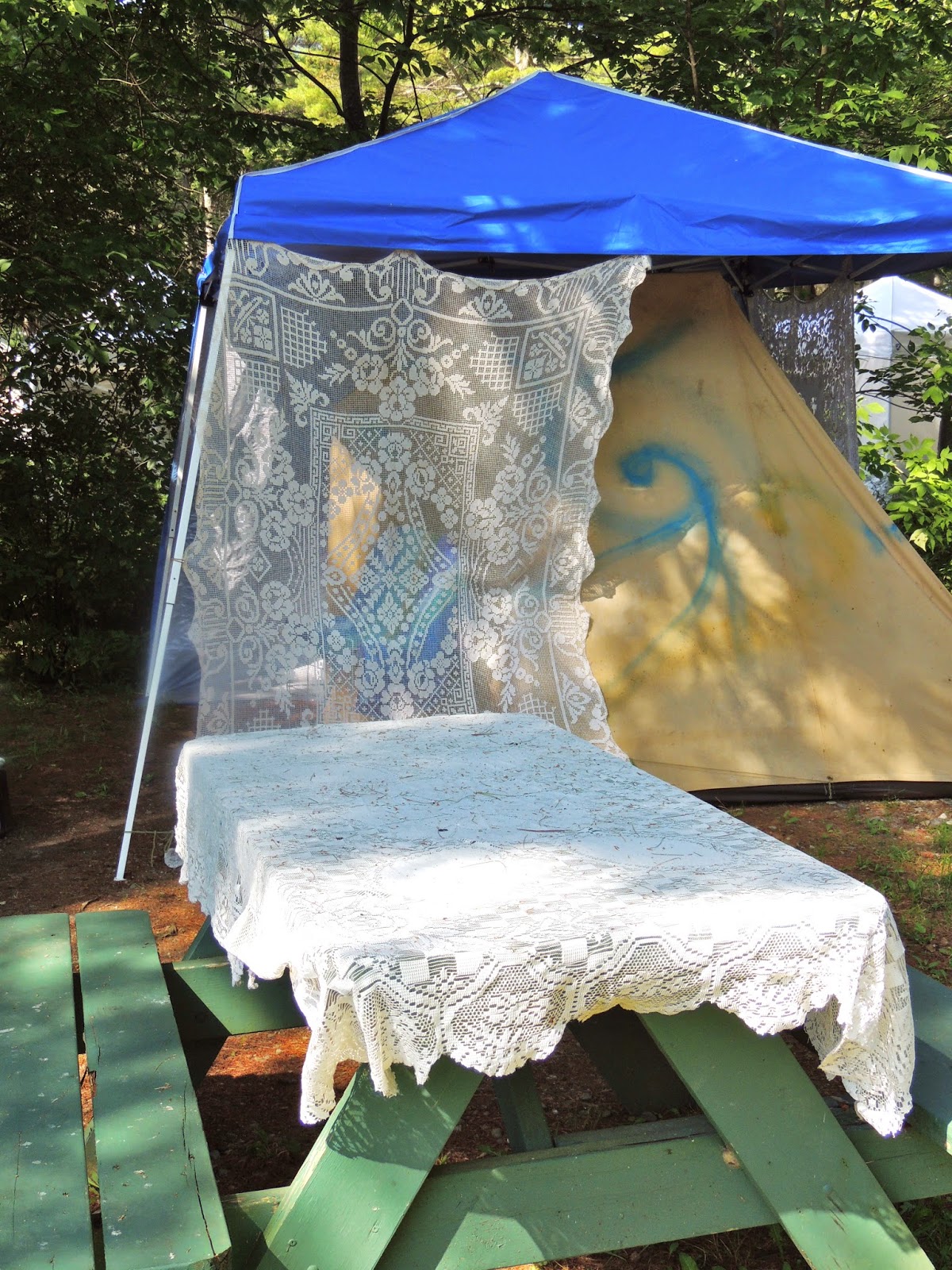
It was an honor to meet Miss China and the Gee's Bend quilters at
Fiber College 2014 in Searsport, Maine. Fiber College is a five-day celebration of creative women and the fiber arts, held at beautiful
Searsport Shores on Penobscot Bay.
I wrote about last year's amazing Fiber College in the post
Summer Camp for Adults. Impossible as it seems, this year was even better! I'll be sharing photos and some great new craft ideas from Fiber College in the next couple of posts . . . I learned too much to fit it all into one!
The quilters from Gee's Bend, Alabama were strong, creative and inspiring women, and their quilts exploded with color in the late summer sun.

The Gee's Bend quilters didn't learn their craft from quilting books or classes. Their knowledge about quilting was passed down from generation to generation, originally inspired by the need of women held as slaves to keep their children warm and, in some cases, to tell their stories when not allowed to read or write.

"The Quilts of Gee's Bend are created by a group of women who live in the isolated
African-American hamlet of
Gee's Bend, Alabama. "The compositions of these quilts contrast dramatically with the ordered regularity associated with many styles of Euro-American quiltmaking. There's a brilliant, improvisational range of approaches to composition that is more often associated with the inventiveness and power of the leading 20th-century abstract painters than it is with textile-making," writes Alvia Wardlaw, curator of Modern and Contemporary Art at the Museum of Fine Arts."
~from Wikipedia
"The quilting tradition in Gee's Bend goes back to the 19th century, when the community was the site of a
cotton plantation owned by a Joseph Gee. Perhaps influenced in part by patterned
African textiles, female slaves pieced together strips of cloth to make bedcovers. Throughout the
post-bellum years and into the 20th century, Gee's Bend women made quilts to keep themselves and their children warm in unheated shacks that lacked running water, telephones and electricity. Along the way they developed a distinctive style, noted for its lively improvisations and geometric simplicity."
~from Wikipedia
"Their quilts have been exhibited at the
Museum of Fine Arts, Houston, the
Indianapolis Museum of Art, the
Philadelphia Museum of Art, and the
Whitney Museum of American Art, among others."
~from Wikipedia
For five days, twenty-five Fiber College quilters had the privilege of learning from, and quilting with, the quilters from Gee's Bend. And the rest of us had the privilege of meeting, and being inspired by, these remarkable women.
Forget the rules you learned about quilting. The original Gee's Bend quilters did not have rotary cutters, Ott lights and metric rulers. They made quilts from scraps of old clothing or bedding, under the worst of conditions, using what they had.
They did without and made do.

They tore fabric to make strips, worked by candlelight, "measured" and balanced colors by doing what looked good when the pieces were laid out on the ground.

Their descendants have continued the quilting traditions of Gee's Bend.

The Gee's Bend quilters don't use patterns to measure and lay out their quilts. They let their quilts "grow", adding pattern and color as they work.
Miss Stella, one of the Gee's Bend quilters, was showing a Fiber College quilter how to balance her pattern as she moved pieces of fabric around on the ground.
No measuring . . . Stella just pointed and said, "The sky should go here".
The quilters of Gee's Bend reminded all of us that sometimes it's OK to ignore the rules to create something beautiful.
Here are some of the quilters of Searsport Shores...
Working side by side with the quilters of Gee's Bend . . .
Exchanging much more than quilting advice.
Quilting allowed women from very different cultures to form close bonds, old to young, woman to woman, over the five days of Fiber College, and to learn from one another . . .
About much more than just cutting and sewing.
Could there ever be a Fiber College as moving as this one?
Where creative women had the opportunity to talk together, work together, and sew together across cultures.
To express themselves

Through the work of their hands.
The quilters of Gee's Bend, led by Miss China, start each day with a prayer, offering up the work of their hands to Jesus. As they work, they often sing. They unselfconsciously shared that tradition with all of us attending Fiber College. One could often hear spirituals loudly, and beautifully, emanating from the quilting tent.
Or from the Art Studio!
Much thanks goes to all of the people who worked so hard to bring the Gee's Bend quilters to Maine, especially Astrig Tanguay (right below) and her husband Steve, owners of
Searsport Shores, who make this event possible each year.
For Fiber College, photographs of the quilts and the women who made them were taken by our friend, Alice Seeger (left in photo above), and bound into a book entitled
Gee's Bend Quilts In Maine.
Copies of the book are $22.00; contact Alice or Astrig at this
email address to check on availability if you would like one.